

Branding and sales material matter less than APIs in white-label payment software. Every authorisation request, webhook, subscription renewal, refund, token, and settlement record travels through an integration layer that needs speed, clarity, and resilience.
This matters for podcast networks, paid-audio platforms, membership communities, advertising marketplaces, and apps selling premium episodes. A failed payment can prevent a listener from accessing content, interrupt a subscription, or delay a creator’s payout.
For founders and PSP teams comparing providers, a platform such as ecomcharge.com belongs in a wider API review that covers uptime, latency, documentation, authentication, versioning, logging, and developer support.
API reliability and transaction performance
Reliable payment APIs need predictable behaviour during normal volume, traffic spikes, retries, and provider outages. A checkout flow loses value when the integration fails under pressure.
Podcast businesses may experience sudden payment demand after a major episode release, live show announcement, advertising campaign, or subscription offer. The payment system must handle those peaks without creating failed purchases or duplicate charges.
Uptime
Uptime is a core operating metric for a PSP platform. Podcast companies need subscription pages, hosted fields, token requests, donation forms, and status endpoints available when listeners are ready to pay.
A provider’s status history deserves review before signing. Teams need to see incident records, maintenance notices, outage communication, and recovery timing rather than relying on a single uptime promise.
For a podcast platform, downtime can mean lost premium subscriptions, missed ticket sales, failed creator memberships, or advertisers being unable to fund campaigns.
Latency
Latency measures how long a request takes to return a response. In payments, slow authorisation creates abandoned checkouts, duplicate customer attempts, and more support contact.
This is especially relevant when listeners purchase a premium feed or unlock an episode inside a mobile app. They expect access immediately after payment.
Latency needs to be reviewed by endpoint. Token creation, payment initiation, subscription renewal, refund requests, webhook delivery, and status lookups each affect a different part of the listener journey.
Transaction status
A high-quality API gives clear status states. “Pending,” “authorised,” “captured,” “failed,” “refunded,” “disputed,” “expired,” and “settled” must mean different things inside the system.
Confusing status labels create reporting problems. Finance teams need to know whether money from a subscription, sponsorship package, live event, or listener donation is authorised, captured, settled, reversed, or still waiting for an external response.
Clear statuses also help podcast platforms decide when to activate or remove access to paid content.
Developer experience and integration quality
Developer experience decides how quickly a PSP team launches, tests, debugs, and extends a payment product. Good API design reduces implementation risk before the first podcast, advertiser, or listener goes live.
API Documentation
Documentation needs endpoint descriptions, request examples, response schemas, test cards, webhook events, error codes, and version notes.
Weak documentation shifts work onto support teams. Engineers then lose time asking basic questions about fields, event order, failed subscription renewals, creator payouts, and required parameters.
For podcast businesses, documentation should also explain recurring billing, saved payment methods, refunds, regional currencies, tax fields, and marketplace-style payment flows.
Sandbox environment
A sandbox needs to behave close to production. It must let developers test approved payments, declined transactions, 3-D Secure flows, subscription renewals, refunds, expired invoices, webhook retries, and settlement-style exports.
A useful sandbox also supports edge cases that matter in payment operations:
- Forced decline codes for issuer-style failures.
- Test webhook replay without opening a new payment.
- Separate credentials for each podcast, advertiser, or merchant profile.
- Sample reconciliation files tied to test transactions.
- Failed and recovered subscription renewals.
- Refunds for cancelled podcast events or membership plans.
Without realistic testing, teams may not discover problems until paying listeners are affected.
Webhooks
Webhooks carry event updates from the payment system to merchant or PSP infrastructure. They matter when payment status changes after the original request.
For example, a podcast platform may use a webhook to activate a private RSS feed after payment, renew access to premium episodes, confirm an advertiser’s deposit, or suspend a membership after repeated payment failure.
Stripe uses event delivery and webhook endpoint handling to keep integrations updated about asynchronous payment events. That model shows why payment software needs signed events, retry logic, timestamps, and event identifiers.
The platform should also prevent the same event from activating access twice or creating duplicate records.
Versioning
API versioning protects integrations from unexpected breaking changes. A provider needs a visible version policy, deprecation notice period, migration guide, and backwards-compatibility rules.
For white-label PSP teams, versioning affects merchant trust. A silent field change in a response body can create downstream errors in subscription dashboards, podcast CRM systems, advertising reports, creator portals, and finance exports.
Security, Logging, and Error Handling
Payment APIs handle money movement and sensitive data, so security and observability need equal attention. A fast API with poor logging still leaves operations teams blind during failures.
Authentication
Authentication needs strong keys, scoped access, key rotation, environment separation, and restricted dashboard permissions.
A podcast platform may need different access levels for finance staff, producers, advertising teams, creators, and external developers. Each person or system should only reach the data and endpoints required for their role.
A PSP team also needs control over which merchants, staff, and systems access each endpoint.
PCI DSS was developed to support consistent payment account data security across the payment lifecycle, which makes tokenisation, access control, and secure handling essential in payment software selection.
Error codes
Error codes need to separate customer mistakes, issuer declines, validation failures, authentication problems, fraud rules, acquirer issues, and internal outages.
One generic error creates confusion for developers and support staff. It can also leave a listener unsure whether to retry, use another card, or contact the podcast platform.
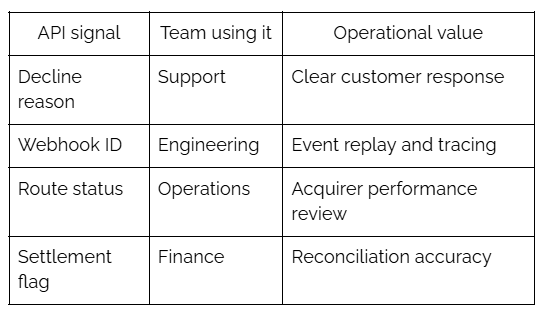
The table shows how error handling affects different teams:
Logging
Logs need request IDs, timestamps, merchant IDs, endpoint names, response times, status changes, and webhook delivery records. Sensitive data needs masking before logs reach dashboards.
Good logging connects one payment across checkout, risk screening, acquirer response, webhook delivery, premium-feed activation, refund action, and settlement export.
That trace reduces manual investigation. It also helps a support team answer practical questions, such as why a listener paid but did not receive access or why an advertiser’s campaign balance was not updated.
Choosing software that podcast teams trust
API quality is a business decision because it affects launch speed, subscription access, approval visibility, support workload, creator payments, and finance accuracy.
A white-label payment platform needs more than a broad feature list. Podcast founders and PSP teams need to inspect documentation, sandbox behaviour, webhook reliability, authentication, rate limits, error codes, logs, versioning, recurring billing, and reporting exports.
Those checks reveal how the software behaves under real operating pressure.
The strongest choice is the platform that lets product, engineering, audience, advertising, support, and finance teams see the same transaction truth. When the API layer is clear, the full podcast payment operation becomes easier to manage and improve.