

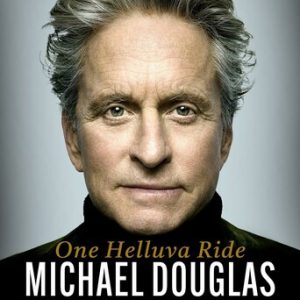
Listen on Audible for free
Try for 30 days, you can cancel whenever you want
Picture a man in his early thirties, known mostly as the handsome son of a screen legend and the star of a cop show, standing on a stage with an Oscar in his hand. The film is One Flew Over the Cuckoo's Nest. He did not act in it. He produced it, from a story his famous father had tried and failed to get made for years. That one night sets up the central question of One Helluva Ride: how do you build a life of your own when your surname arrived before you did?
Michael Douglas has waited until his eighties to answer it, and he has waited on purpose. He has said plainly that he could not have written this book while Kirk Douglas was alive, because the early chapters deal with a father who hit his sons. That is the thread that runs under everything else here: the drugs, the affairs, the turbulent first marriage, the stage four tongue cancer he was once told would kill him, and the fight to pull his son Cameron back from an addiction that cost him seven years in a federal prison.
It is a long listen, at around nineteen hours, but it rarely drags. Douglas organises his life around twelve of his own films, from The China Syndrome and Romancing the Stone through Fatal Attraction, Wall Street and Basic Instinct to Traffic and Behind the Candelabra. Each film becomes a doorway into whatever was happening off screen at the time. The structure is a smart producer's trick. It keeps the gossip anchored to something, and it keeps the darker material from sinking the whole book.
What the stories are actually like
The publisher promises outrageous anecdotes, and for once the promise holds. Douglas paid for part of his college years by selling marijuana. He describes the on-set affair with his Romancing the Stone co-star without excuses. He recounts a threat involving an HIV-infected needle at the Academy Awards, and a cancer diagnosis that was initially missed. None of this is told for shock alone. The tone is closer to a man emptying his pockets on the table and saying, here it all is.
The best moment is small. After Douglas won his acting Oscar for Wall Street, his father told him he would have been nicer to him had he known how successful he was going to be. Douglas repeats the line without comment. It lands harder than any of the Hollywood stories around it.
What the critics have said so far
Early reviews have been warm. Kirkus Reviews called the book a substantive, dishy and entertaining glimpse into Hollywood royalty, and noted that Douglas, as a producer, knows a story needs clarity and conflict to work. The Wrap went further, calling it one of the best books you are likely to read about filmmaking, and praised him for being open about his own shortcomings rather than sugarcoating them. The New York Times described it as a blockbuster, intimate and uncensored.
One honest caveat. This is a star's memoir, and the second half spends a great deal of time on marriage, family and illness rather than on film sets. If you only want the making-of material, the middle stretch is the richest part. If you want the man, stay to the end.
Why the audio edition is the one to get
Douglas reads the whole thing himself, and that is the point of buying it in this form. The voice is instantly recognisable, a little gravelled now, and it belongs to someone who has spent fifty years learning how to deliver a line. When he gets to Gordon Gekko, you hear a performer revisiting a part rather than an author summarising one. When he gets to his father, or to Cameron, or to the cancer ward, the pacing slows and the famous confidence drops away. A hired narrator could not do that, however good.
The Headline edition is unabridged, so nothing from the print book has been trimmed. The twelve-film structure makes it easy to listen in chunks, one film and one era at a time.
The man behind the microphone
Michael Douglas has never published a book before, which is partly why this one took so long. The screenwriter Shane Salerno spent years urging him to write it. Douglas finally agreed after finishing Franklin in 2022 and stepping back from acting, and he has said he was spurred on by the memory of his father, who wrote nine books of his own. The writing took about eighteen months, with the Deadline journalist Mike Fleming Jr. involved in the early stages.
He is one of the few people to have won Oscars for both producing and acting, and his marriage to Catherine Zeta-Jones, now past twenty-five years, gives the book its hopeful final act. If you have ever watched one of his films on a Sunday afternoon and wondered what the man was really like, the Audible free trial covers this one in full.
This content contains affiliate links. When you buy through these links, we may earn an affiliate commission. Host: Michael Douglas
Country: United Kingdom
Average duration: 19 hours and 15 minutes
Frequency: Audiobook
Producer: Audible
Country: United Kingdom
Average duration: 19 hours and 15 minutes
Frequency: Audiobook
Producer: Audible
Audiobooks like One Helluva Ride
 Flybot
 The Let Them Theory: A Life-Changing Tool That Millions of People Can’t Stop Talking About
  Onyx Storm: Empyrean, Book 3
 Nexus: A Brief History of Information Networks from the Stone Age to AI
 Odyssey: Stephen Fry's Greek Myths, Book 4
 Redwood: The Untold Story of the Cold War's Most Extraordinary Spy
 The Margate Murders
 We Solve Murders
 Not Till We Are Lost: Bobiverse, Book 5
 The Wonder of Stevie
 Harry Potter and the Half-Blood Prince (Full-Cast Edition)
 Harry Potter and the Order of the Phoenix (Full-Cast Edition)
 Harry Potter and the Philosopher’s Stone (Full-Cast Edition)
 Harry Potter and the Prisoner of Azkaban (Full-Cast Edition)
  It Could Have Been Her
 Michael
 Poison Garden: The DCI Ryan Mysteries, Book 22
 Recall
 Red Dwarf: Titan
 Swan Song: Diana, my sister
 The Hotel Avocado
 The Murder at the Vicarage
 The Other Patient
 Unleashed
 Vibe: The Secrets of Strong Connections in a Lonely World
 We Chase Shadows
 A Deadly Episode
  A Great Book with Barack Obama
 A Parade of Horribles: Dungeon Crawler Carl, Book 8
 Big Little Truths