

Listen on Audible for free
Try for 30 days, you can cancel whenever you want
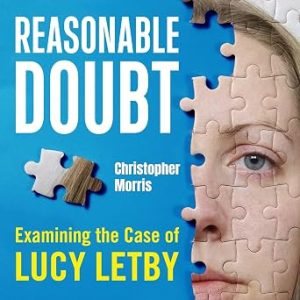
Few British criminal cases of the last decade have generated as much public argument as the conviction of Lucy Letby, the neonatal nurse found guilty of murdering babies at the Countess of Chester Hospital. Reasonable Doubt: Examining the Case of Lucy Letby, released on Audible on 24 July 2026 by Bath Publishing and read by its author Christopher Morris, is a sixteen-and-a-half-hour attempt to set out, in order and at length, why a growing number of specialists believe that conviction does not hold up.
Morris is explicit about where he stands. He believes Letby has been the victim of a miscarriage of justice and that the verdict was not reached beyond reasonable doubt. This is not a neutral survey of the case and it does not pretend to be. What it offers instead is the argument for the defence, assembled with a thoroughness the trial itself arguably never saw.
The case that was never put
The spine of the book is a fact that Morris returns to repeatedly and that remains genuinely striking: the defence called no expert witness to challenge the medical evidence presented by the prosecution. Nobody outside Letby's legal team knows why. For a case that turned almost entirely on the interpretation of clinical detail, that absence created a courtroom in which one side's reading of the science went effectively unopposed.
From there Morris works through the three pillars that critics have attacked since the verdict. The medical explanations for how the babies died, several of which have been publicly disputed by neonatologists and pathologists of considerable standing. The reliance on circumstantial evidence, particularly the shift rota that placed Letby on the ward when deaths occurred. And the statistics, an area where the courts have a long and unhappy history stretching back to earlier prosecutions of mothers accused of harming their children.
Where the sixteen hours go
This is a long listen and the length is not padding. Morris has interviewed scores of experts, read the trial transcripts and worked through thousands of documents submitted to the Thirlwall Inquiry, the statutory inquiry examining what went wrong at the hospital. The book moves at the pace of someone showing their working rather than someone building to a reveal, and listeners who want a punchy true-crime narrative should know that in advance.
The payoff is that the argument becomes cumulative rather than rhetorical. Individually, most of the objections Morris raises have been aired in newspapers and on television over the past two years. Heard consecutively, with the reasoning attached, they land differently. Whether or not a listener finishes persuaded, they will finish with a far clearer picture of what the disagreement is actually about, which is more than most coverage of this case has managed.
An author reading his own argument
Morris narrates the book himself, and it is the right call for material like this. He reads plainly, without the portentous delivery that afflicts so much true crime, and the restraint matters when the subject is the deaths of babies and the reputation of a woman serving whole-life terms. There is no scoring of points and no theatrical outrage. Complex medical and statistical passages are taken slowly enough to follow, which in an audiobook is not a small technical achievement.
A caveat worth stating: an author narrating his own advocacy is, by definition, not a neutral voice, and the calm delivery can make a contested reading of the evidence sound more settled than it is. Listeners should hear this alongside the prosecution case rather than instead of it. Morris does not hide his position, but the format quietly reinforces it.
The conviction stands, the legal process continues, and nothing in this audiobook changes either of those things. What it does is lay out, methodically and in public, why serious people in medicine, statistics and law are uneasy about how it was reached. Morris argues that the answer matters beyond one nurse, because it goes to whether the justice system is built to find the truth or merely to produce a verdict. On that question Reasonable Doubt is essential listening, whichever conclusion you arrive at.
This content contains affiliate links. When you buy through these links, we may earn an affiliate commission. Host: Christopher Morris (Author, Narrator)
Country: United Kingdom
Average duration: 16 hours and 28 minutes
Frequency: Audiobook
Producer: Audible
Country: United Kingdom
Average duration: 16 hours and 28 minutes
Frequency: Audiobook
Producer: Audible
Audiobooks like Reasonable Doubt: Examining the Case of Lucy Letby
 Flybot
 The Let Them Theory: A Life-Changing Tool That Millions of People Can’t Stop Talking About
  The Madman's Hotel
 London Falling
 Murder at the Grand Alpine Hotel
 Nexus: A Brief History of Information Networks from the Stone Age to AI
 Odyssey: Stephen Fry's Greek Myths, Book 4
 Verity
 We Solve Murders
 The Mysterious Affair at Styles
 Adam Buxton's Successpod
 French & Saunders: Titting About (Series 7)
 Harry Potter and the Deathly Hallows (Full-Cast Edition)
 Harry Potter and the Goblet of Fire (Full-Cast Edition)
 Harry Potter and the Half-Blood Prince (Full-Cast Edition)
 It Could Have Been Her
 Jilly Cooper's A Pressing Engagement
 Land
Land Recall
 Red Dwarf: Titan
 Starlings
 The Castle: Adventures in a World of Unravelling Men
 The Hotel Avocado
 The Murder at the Vicarage
 Unleashed
 A Great Book with Barack Obama
 A Parade of Horribles: Dungeon Crawler Carl, Book 8
 Backfired: Attention Deficit
 Boom Town
 Dungeon Crawler Carl